
DoorKing Gate Repair in Suffolk: A Homeowner’s Guide
Most DoorKing operators don’t fail because the mechanical hardware wears out. They fail because a technician who doesn’t know the brand treats a five-dollar terminal block problem like a dead control board. If your gate has stopped responding and you’re in Suffolk, the first thing worth knowing is this: DoorKing systems are built to outlast their own accessories, and the box that looks dead often isn’t. We work on DoorKing systems across Suffolk and see the same handful of failure patterns again and again. If you’d rather skip the detective work and get a straight diagnosis, call (855) 360-8054.
What You Actually Own When You Own a DoorKing System
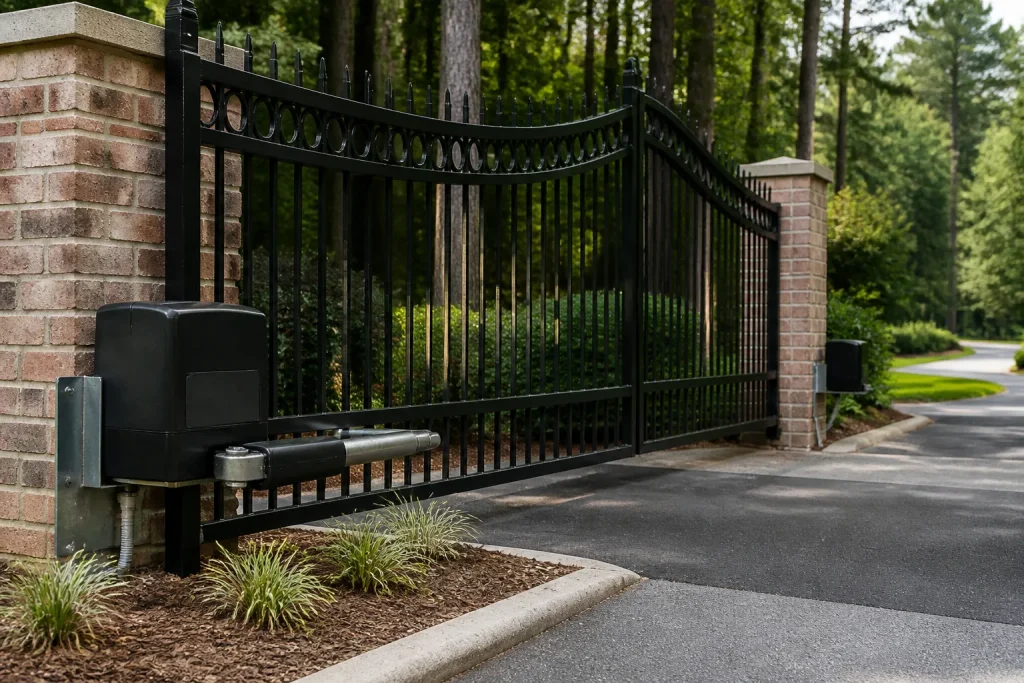
DoorKing builds gate operators and telephone entry systems as separate but connected pieces of hardware. That distinction matters in Suffolk, because most failures start in one unit and get blamed on the other. The operator is the motor and arm that physically swings or slides the gate. The telephone entry system is the pedestal or wall unit your visitors use to call up to the house. They communicate over low-voltage wiring, and when that link breaks down, both sides can look broken at once.
A typical residential DoorKing setup includes a few core components:
- The operator unit – the motor housing and control board that moves the gate
- The telephone entry board – the keypad, directory, and call station your visitors interact with
- The low-voltage terminal block – where the wiring between the two connects
- The access control board – the logic layer that decides who gets in and when
- Safety edges and loop detectors – the sensors that stop the gate if something’s in the way
The reason this matters: a DoorKing system can have a perfectly healthy operator and a dying entry board, or the reverse. Misreading which one is at fault is the single most common cause of an unnecessary replacement quote in Suffolk.
Why DoorKing Error Codes Are Read Two Different Ways
DoorKing’s 1835 and 1838 series telephone entry systems display error codes on their own display, separate from the diagnostic readout on the operator. Those two readouts don’t always tell the same story, and that’s exactly where generic gate technicians get lost. The entry system might flash a code that suggests a communication failure, while the operator is showing a condition that points to a limit switch or a voltage drop. Read one without the other, and you diagnose the wrong component.
In our experience working on DoorKing systems around Suffolk, the right approach is to read both displays at the same time, cross-reference them, and then test the low-voltage run between them with a meter. When the codes on the entry unit and the operator contradict each other, the wiring between them is usually the culprit. When they agree, the fault is almost always in the component the shared code points to.
This is also why brand familiarity matters when you’re choosing who works on your gate. DoorKing’s programming interface is proprietary. A technician who works mainly on LiftMaster, FAAC, or BFT systems can repair the mechanical parts of a DoorKing gate, but without familiarity with DoorKing’s own programming environment they can’t fully interrogate the board or reprogram access after a repair. We’re experienced with all of those brands plus Viking, Ghost Controls, and Elite, and DoorKing’s software environment is its own thing.
The Suffolk Failure Pattern: Corrosion at the Low-Voltage Terminal Block
Here’s the failure we see more than any other on DoorKing systems in Suffolk, and it’s the one most often diagnosed as something much bigger. The low-voltage terminal block, where the field wiring meets the control board, is directly exposed to seasonal humidity. Over time, moisture works its way into those small screw terminals and corrodes the connection points. The result is intermittent voltage that the control board reads as a full communication failure. The board looks dead. The gate won’t move. A technician unfamiliar with the pattern quotes a board replacement.
What’s actually happening is a connection problem at the terminal block. Cleaning the terminals and re-seating the wiring restores the circuit in most cases, and it costs a fraction of a board swap. Some signs to look for before you assume the worst:
- The gate works fine in dry weather and fails after rain or on humid mornings
- The entry system display flickers or shows intermittent codes rather than a steady fault
- The operator responds to a manual command but not to a remote or keypad signal
- Nothing has changed mechanically – the gate moves freely by hand when the operator is disengaged
If two or more of those line up, ask specifically for a terminal block and low-voltage wiring check before anyone quotes you a new board.
DoorKing Parts: What’s Available and What Takes Time
Parts availability shapes repair timelines more than most homeowners expect, and DoorKing is no exception. The good news is that the most commonly failed components – terminal blocks, wiring harnesses, safety edges, and many standard control boards – are typically available from domestic suppliers and can be sourced quickly. That means the repair that starts this week often finishes this week.
The components that can slow things down are the less common ones: specialty entry system boards, discontinued display modules, and operator-specific parts for older installations. Those can require factory lead times, sometimes measured in weeks rather than days. In Suffolk, where a lot of DoorKing systems were installed years ago and are still running, this matters. It’s why a technician who can accurately diagnose which part is actually failed – rather than ordering a replacement for the whole unit – saves you both time and money.
What you should expect from any repair company is a straight answer on which parts are in stock, which need to be ordered, and what that does to your timeline. A written estimate should spell out both the part and the expected lead time before any work begins.
Repair or Upgrade? What DoorKing’s Modular Design Allows
This is where DoorKing earns its reputation for longevity. The brand’s modular construction means the operator and the access control layer are separate systems that can be updated independently. Many DoorKing systems installed in the early 2000s still have perfectly serviceable mechanical operators. The motor, arm, and hinges are healthy. What’s dated is the access control side – the entry system, the keypad, the programming.
In our experience across Suffolk, the right answer for those systems is usually not a full replacement. It’s an access control update on top of the existing operator. That gets you modern keypad and entry capability without the cost of a new mechanical drive. The rule of thumb we work from is this: if the operator moves the gate reliably and the mechanical components are sound, update the control layer. If the operator itself is failing, or the mechanical parts are beyond repair, that’s when replacement makes sense.
Repair-first is the way we approach every DoorKing job. We’d rather tell you the board you were quoted doesn’t need replacing than sell you a system you don’t need. If you’re weighing repair against upgrade in Suffolk, a free on-site estimate is the cheapest way to get a straight answer. Call (855) 360-8054.
When to Call a Pro
Any DoorKing repair that involves the operator’s power supply, the control board, or the low-voltage wiring between the entry system and the operator is a job for a trained technician. Gate operators run on line voltage and store mechanical force in the drive mechanism, and a mistake on the electrical side can cause injury or damage the system further. Safety edges, limit switches, and programming on the control board are similarly not DIY territory. If you’re seeing intermittent faults, error codes you can’t reconcile, or a gate that won’t move and you’ve already checked that nothing mechanical is jammed, that’s the moment to bring in someone who works on the brand.
Related services in Suffolk: if your gate is electric and the issue is in the operator or control board, our electric gate repair covers the diagnostic side in full. If the problem is mechanical – hinges, arms, or the gate panel itself – our gate repair service handles that work. And if you’re starting fresh with a new system, we handle installation as well as Gate Repair Suffolk repairs across the area. If you’re somewhere else in the region, our Suffolk service page has the full picture of what we cover.
The Bottom Line
DoorKing systems are built to last, and most of what goes wrong with them in Suffolk isn’t the hardware – it’s the connection between the components. The key takeaways:
- Read the entry system display and the operator display together; they tell different parts of the same story
- Corrosion at the low-voltage terminal block is the most common DoorKing failure in Suffolk and often mimics a board failure
- DoorKing’s proprietary programming environment means brand familiarity matters when you choose who works on your gate
- Most standard DoorKing parts are available domestically; less common boards can take longer
- Many older DoorKing systems can be updated with modern access control without replacing the mechanical operator
If you’re in Suffolk and need help with a DoorKing system, Gate Repair Suffolk offers free estimates – call (855) 360-8054. We answer 24/7. Fast dispatch from 7am to 7pm, Sunday through Friday. Our technicians have up to 10 years of experience, and we work on DoorKing as well as LiftMaster, FAAC, BFT, Linear, Viking, Ghost Controls, Elite, and Mighty Mule systems. Repair first, always.
Frequently Asked Questions
Intermittent DoorKing failures are most often caused by moisture at the low-voltage terminal block, where corrosion creates a connection that comes and goes with humidity. It can also be a failing safety edge or a loose limit switch. The pattern – works in dry weather, fails after rain – points to the terminal block first.
Sometimes. A general technician can handle the mechanical parts, but DoorKing’s programming interface is proprietary, and without familiarity with it they can’t fully read the board’s error codes or reprogram access after a repair. For anything involving the control board or the entry system, you want a technician who works with DoorKing regularly.
If the gate moves freely by hand when disengaged, the entry system shows flickering or intermittent codes, and the failure comes and goes with weather, it’s usually wiring and not the board. A proper diagnosis reads both the entry system and the operator displays, then tests the low-voltage run with a meter before quoting a replacement.
Older DoorKing systems are often worth repairing because the operator and the access control are separate and can be updated independently. If the mechanical operator is sound, you can usually update just the access control layer rather than replace the whole system. A free estimate will tell you which path makes sense for your specific unit.
Written by the team at Gate Repair Suffolk.
Need Gate Repair Help?
Call Gate Repair Suffolk - licensed & insured, here with fast help in Suffolk.
(855) 360-8054